Stop Guessing Your Next Move: A Career Change Framework in Action
By Ray Giese, CCSP, MS
Career Coach & Career Prism Method℠ Strategist
Career & Financial Pathways LLC
The Framework in Action
You've now met my colleagues Jim, Shamoon, and Stephanie. They've walked you through Genius, Energy, Motives, and Sparks as individual pieces of career design through the previous posts in this series:
But knowing the pieces is different from seeing them in action.
I've had four careers across seven industries over fifty years. Each pivot felt necessary. But each one could have been avoided if I'd understood one thing: how my Genius, Energy, Motives, and Sparks - my G.E.M.S. - actually function together—not in theory, but in the real, messy work of career decisions. Earlier in my career, I needed a career-change framework I could use as a foundation for sustained success.
When all four align, you get what I finally found midway through my career - the kind of career that sustains itself. You wake up energized. Your work honors your values. Your natural abilities are exactly what the job demands. The problems you're solving pull you forward.
When they're misaligned, you get my first 12 years: three challenging pivots, anxiety, frustration, economic setback, and the growing sense that I was missing something fundamental.
I'm Ray, founder of Career Prism Network, and I'm my own best case study. Here's how one framework—and my complete G.E.M.S. Profile—explains four careers in action.
Here's What My G.E.M.S. Looks Like
My Personal Summary
My G.E.M.S. Profile is the foundation of my professional success. It synthesizes comprehensive assessments designed to help me understand my unique traits by measuring my Genius (Abilities), Energy (Personality), Motives (Values), and Sparks (Interests). I am a collaborative and visionary leader who combines deep empathy with logical, step-by-step problem-solving to drive meaningful change. Energized by team environments and long-term strategic planning, I excel at motivating others and fostering harmonious, productive relationships. In a nutshell, if you want to get something strategically important done, bring me into the room.
This summary doesn't describe who I aspire to be. It describes who I already am. And that distinction changes everything.
My Genius (What I'm Built to Do):
Break down complex ideas into clear, logical sequences (so others can understand)
Generate a high volume of ideas and pivot quickly when needed
Learn best by being active and mobile (not desk-bound)
Retain facts, figures, and numerical data automatically
Listen to problems and create structured, step-by-step solutions
Coach and help people reach their goals
Sell and persuade others to see my perspective
Foster productive conversations and motivate groups
Teach and break down complex topics for easy understanding
Translation: I'm a strategist and collaborative networker who thrives on relationships and forward momentum, not on detail work or isolation. Give me a complex problem to solve with a team, and I come alive.
My Energy (How I Operate):
Draw energy from interacting with others (extroversion, but also needing some alone time to rest)
Thrive in team environments and collaborative settings
Maintain laser focus on long-term strategic goals (3-5+ years out)
Deeply attuned to emotions and motivations of people around me
Create structure and clear plans in place of chaos and uncertainty
Hold myself to high performance standards continuously
Refine ideas best through talking them out loud with others
Prioritize harmony and use diplomacy to resolve conflicts
Speak up for what I believe is right and align work with core values
Maintain a naturally hopeful outlook that keeps teams energized
Translation: I'm an extroverted strategist who builds trust through genuine connection. I need team environments, autonomy to generate ideas, and clear structure—not micromanagement, isolation, or bureaucratic oversight.
My Motives (What Matters to Me - My “Internal Compass”):
Helping Others — Tangible difference in people's lives matters
Leadership & Influence — Guiding teams toward common objectives
Moral Fulfillment — Values alignment is non-negotiable; I cannot compromise integrity
Mental Stimulation — Complex challenges keep my mind sharp
Sense of Accomplishment — Need to see tangible results of my work
Competence — Want to function at a high capability level
Financial Security — Support my family and lifestyle without financial anxiety
Nurturing Potential — Deep satisfaction in developing others
Wisdom & Teaching — Mentoring colleagues and clients
Job Tranquility — Freedom from chronic stress and toxic conflict
Health & Well-being — Won't sacrifice overall wellness for advancement
Societal Impact — Work that contributes to a better, fairer world
Translation: I need work that matters, teams I can lead, values alignment, and competitive compensation. If any of these is missing, I'll eventually leave—regardless of how successful I appear.
My Sparks (What Draws Me):
Empowering others through teaching and mentoring
Business process creation and building from scratch
Financial and career guidance (helping others secure their futures)
Process improvement and efficiency gains
Human behavior and history (understanding motivation)
Fostering empathy and mutual understanding
Setting things up the right way from the start
Making something that matters (purposeful work)
Building something big (large-scale projects)
Social dynamics and community collaboration
Enterprising leadership and ambitious initiatives
Investigative analysis and uncovering facts
Translation: I'm drawn to growth, collaboration, and meaning. I want to build, teach, lead, and create impact—not maintain the status quo.

Pre-Career: The Foundation Years (Ages 12-22)
My first official year of reportable taxable earnings was 1966, for $117. I was twelve years old, working in a laundry doing odd jobs. Before that, I sold newspapers at a corner and on a neighborhood delivery route. I also worked as a "soda jerk" serving ice cream at a neighborhood pharmacy. Then I worked for a transportation company, shuttling passengers from Chicago airports to downtown hotels—work I did throughout high school and college that paid for my education.
My parents never had to push me. The work felt natural. I built relationships, solved logistical problems, and thrived on human interaction.
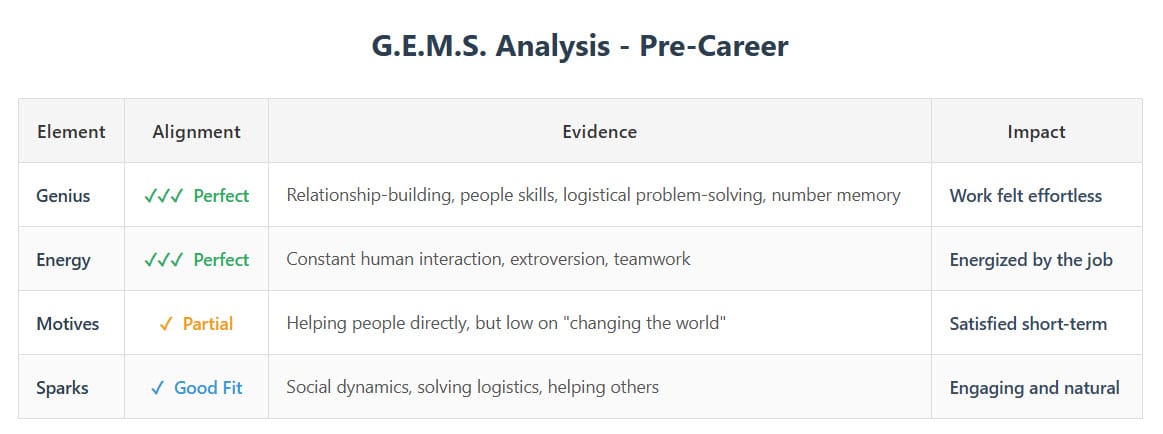
The Key Insight: I didn't have language for what was happening, but my Genius and Energy were perfectly aligned. The work felt like play because I was doing exactly what I'm built to do. This is what alignment feels like at age twelve.
Why It Worked: I used all my natural abilities. The work demanded relationship-building, quick thinking, and logistics—exactly my strengths. No mismatch. No friction. No burnout.
Why I Left: This was never meant to be a career—it was to fund my education. Yet, when I graduated, the company urged me to stay and build a career. I left because my Sparks weren't aligned, yet I could have had a successful, albeit somewhat less fulfilling, career. But the pattern matters: when G and E align, you excel. The question is always whether M and S are satisfied too.
Career 1: The Energy Mismatch
Science Teacher → Environmental Consultant (The Mismatch)
I attended college to become a science teacher. My degree was in science. The plan was clear.
But many other Baby Boomers had the same plan—thousands of them. The profession was blocked.
The environmental movement was booming—new laws protecting water, air, and land. My science degree was a ticket into environmental consulting. I conducted environmental impact assessments for new developments. The recession of 1979 hit, and I was forced to pivot to the Environmental Protection Agency - a strict, bureaucratic structure. No discussion, no ideas, no debate - just show up, shuffle papers, and dole out grant monies. The work was meaningful. My values were aligned. My mission was clear.
But something was wrong. I sat in technical isolation, analyzing data, when I needed to build relationships and move ideas around a room. I craved interaction and ideas that would create more efficient processes. I craved collaboration. I craved the energy of working with people. I craved being recognized for my efforts. My Dad told me, “Keep your head down, show up, do the work, and realize the longer-term benefits and job security of Federal employment.” Sorry, not for me.
Within a few years, I grew anxious and realized it wouldn't be a fit.
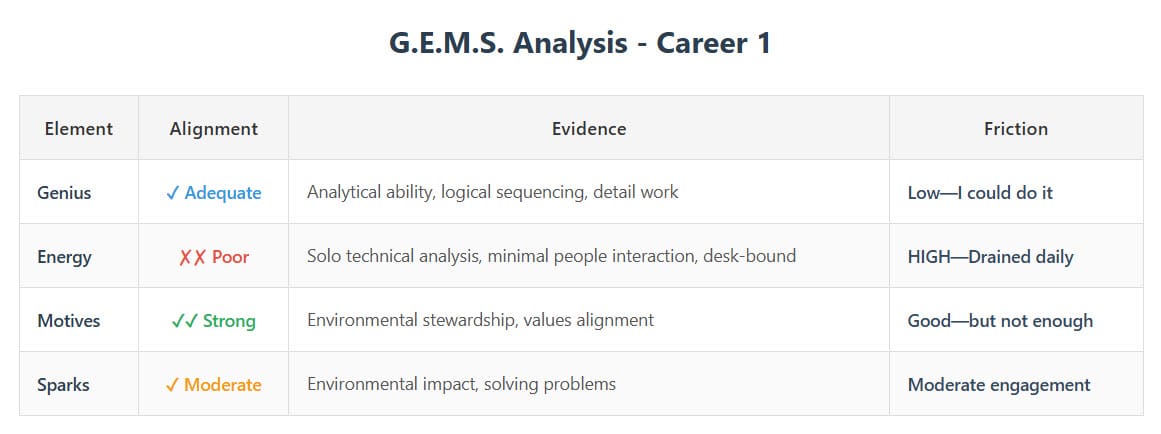
The Friction: My Genius was adequate. My Motives were strongly aligned. But my Energy—my need for constant collaboration, relationship-building, and movement—was starved. I was forcing myself into a role that violated my natural way of operating.
The Key Insight: One strong aligned element cannot overcome three misaligned ones. I was becoming anxious, and I didn't understand why. My values were honored, but my personality was being suppressed. Over time, suppression becomes resentment.
Why It Failed: Even when your values are perfectly aligned, if your Genius and Energy aren't engaged, you'll eventually burn out. I was trying to force myself into a box that didn't fit my shape.
Career 2: The Temptation
Stockbroker (What Happens When Genius & Energy Align But Motives Betray You)
1,500 people applied for broker training. I was among the 50 selected.
I had no business background. No investment experience. But they saw in me (what I didn't yet understand about myself) an enthusiastic idea generator who could earn others' confidence. I would build expertise as I built my client base.
I passed my licensing exam and began soliciting clients. I leaned into my Energy and my Sparks. I captured new clients rapidly. I won office competitions. Of my class of 50, I was the first to graduate to a regular office and assume full broker duties.
On the surface, it was a success story.
But underneath, something was breaking.
What was I doing? Were the transactions I recommended good for my clients, or was I just generating commissions? The question weighed on me constantly. My boss said, “Don’t think about what you are selling, just keep the money moving.” By my third year, it was affecting my work. I learned a hard lesson: no matter the good fortune or payout, my values were worth so much more.
I had to walk away.
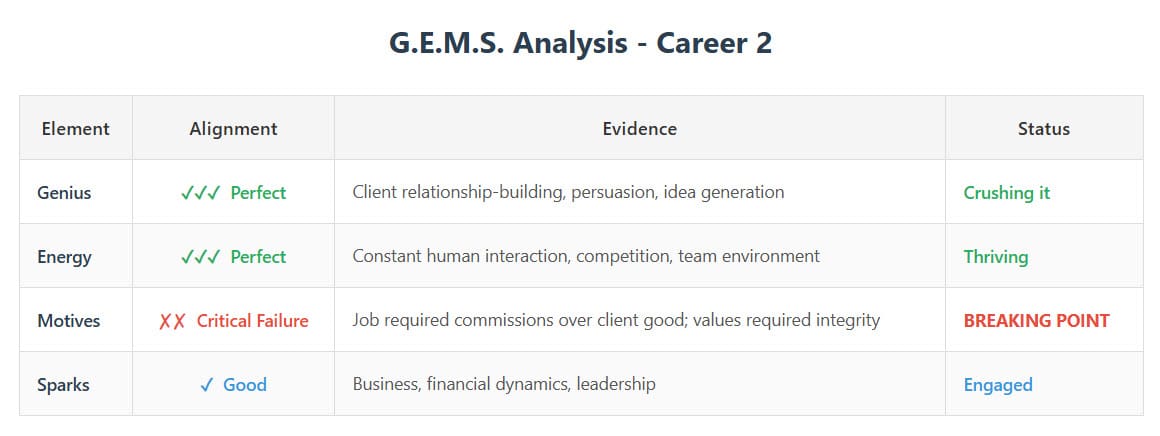
The Friction:
Here's the brutal truth: when Genius and Energy are perfectly aligned, you excel. You win competitions. You make good money. You look like you're winning.
But if your Motives—your ethical core—are being violated, none of it matters. Success built on values misalignment is not success. It's a slow poison.
The Key Insight:
I discovered that my Motives weren't aspirational—they were non-negotiable. Moral fulfillment isn't a nice-to-have. It's load-bearing. Remove it, and the whole structure collapses.
You cannot perform your way out of values misalignment. Genius and Energy can mask a broken Motive, but only temporarily. Eventually, your conscience catches up.
Why It Failed: Staying cost more than leaving—even with significant financial sacrifice. Integrity cannot be outsourced or compromised. Not permanently.
Footnote: While I moved on from the financial services industry, timing also played a role. When I left, the industry was pivoting to fiduciary, fee-for-service financial planning. I eventually earned my Certified Financial Planner Professional designation and could likely have found a better fit in that context. However, the industry pivot was in its infancy, and opportunities were limited within the handful of established firms. The alternative of starting my own practice and flying solo conflicted with my preference for team collaboration, so it wasn't an option for me.
Being a new parent with a growing family, I needed a more dependable source of income - thus my need to move on. Yet, I never let go of my interest in personal finance and investing - as I eventually earned an MA in Personal Finance from Kansas State University. My current role as a Career Coach started with personal finance in mind - helping people improve their earning power through better career planning - so my previous “Spark” was never lost. There are ways to find “new homes” for your passions.
The Turning Point
The Highlands Assessment: The Language I Didn't Know I Was Missing
About this time, I sought help from a career consultant and took a critical assessment: the Highlands Ability Battery.
This moment changed everything.
Until then, I had intuition but no language. I knew something wasn't working. I couldn't articulate why. I couldn't see the pattern. The Highlands results confirmed my instincts and gave my feelings a voice—new words and phrases I could use to understand myself better.
For the first time, I had a framework. I had labels for what came naturally to me. I could see why certain environments energized me, and others drained me. I could see why some careers fit and others didn't.
The assessment didn't tell me who to be—it revealed who I already was.
Here's what changed:
I went from reactive to intentional.
Before: Try something, succeed at first, feel misaligned for unclear reasons, burn out, pivot desperately.
After: Look at an opportunity and immediately assess:
Does this fit my Genius?
Will my Energy be nourished or drained?
Are my Motives aligned?
Will I be drawn to the work?
I stopped asking, "Can I do this job?" and started asking, "Should I do this job?"
Two very different questions.
The Framework Became My Compass:
Genius told me what comes naturally (my vehicle)
Energy told me the cost and rhythm (my pace)
Motives told me what I won't compromise (my values)
Sparks told me what pulls me forward (my draw)
For the first time, I had a complete structure and foundation.
Career 3: The Intentional Design
Strategic Accounts (What 28 Years of Alignment Looks Like)
The financial industry taught me how to sell. I combined that skill with my knowledge of the environmental industry and landed a role as Marketing & Sales Director at an environmental services company.
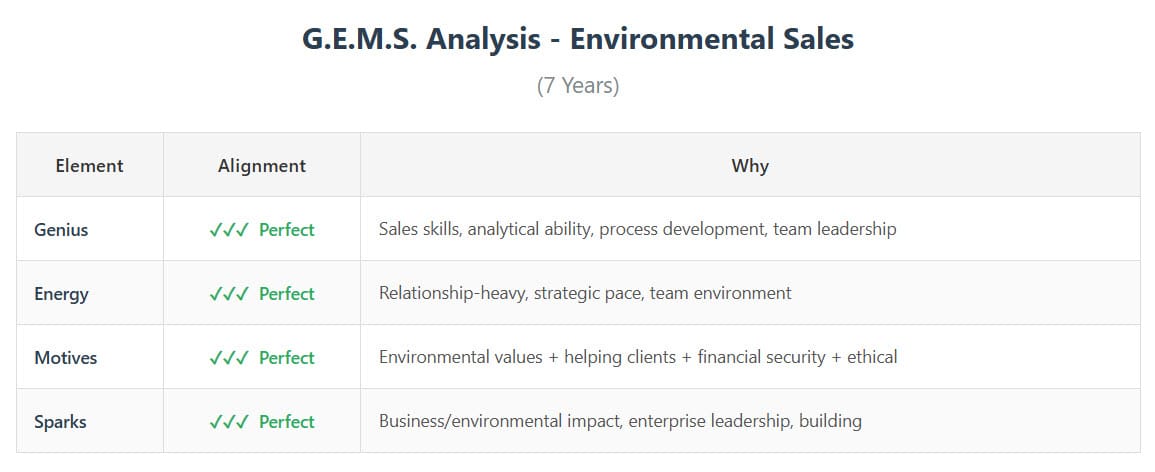
Now I was working intentionally. My Genius, Energy, Sparks, and Motives were all aligned. The longer sales cycle matched my natural pace. My values were honored. My team needed exactly what I could deliver. My curiosity about environmental impact was engaged every single day.
I helped secure some of the company's largest contracts with major industrial clients nationwide. I led key projects and delivered notable results with my teams.
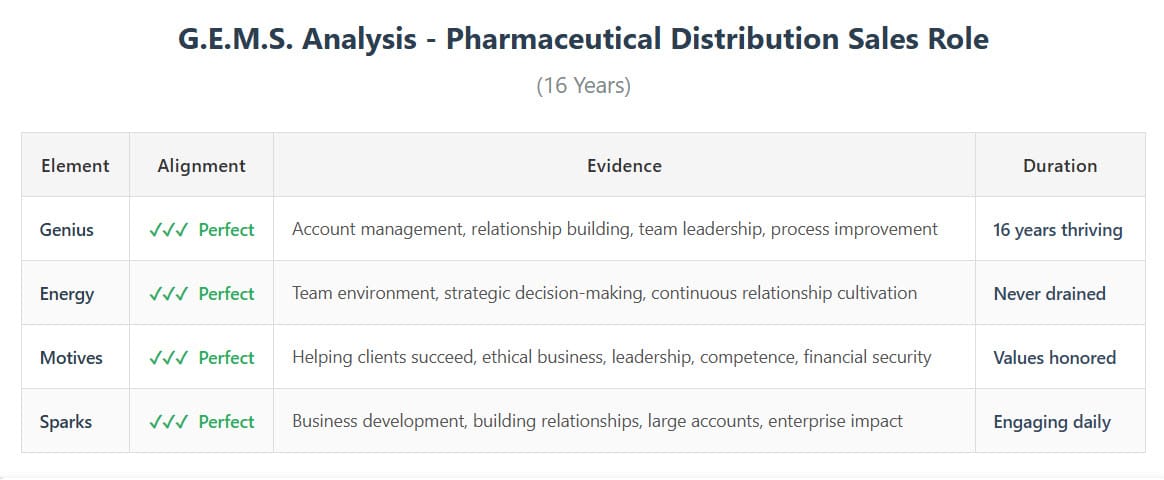
After nearly ten years with three different companies, a few mergers got in the way. Rather than move my family or take a different role, I moved into large-account management at a national pharmaceutical distribution firm as VP, Strategic Accounts. I managed one of the company's largest client relationships.
The years that followed were the most rewarding of my career.
The Results:
12 years in Environmental Sales
16-year tenure in Pharmaceutical Sales (longest role ever)
Served as VP with responsibility for the largest client relationships
Compensation reflected excellence
Trusted with major strategic decisions
Retired at 62 with 50 years of work, 40 professional
"I was hitting on all cylinders—and my purpose and prosperity reflected it"
The Key Insight:
When all four elements are aligned, career design stops being a struggle and becomes a rhythm. You're not managing your energy; you're gaining it. You're not compromising your values; you're living them. You're not forcing your Genius to fit the role; the role was built for how you work.
Alignment compounds. A career built on all four elements sustains itself.
Why Patterns Matter
Four Careers, Seven Industries—One Throughline
The Arc:
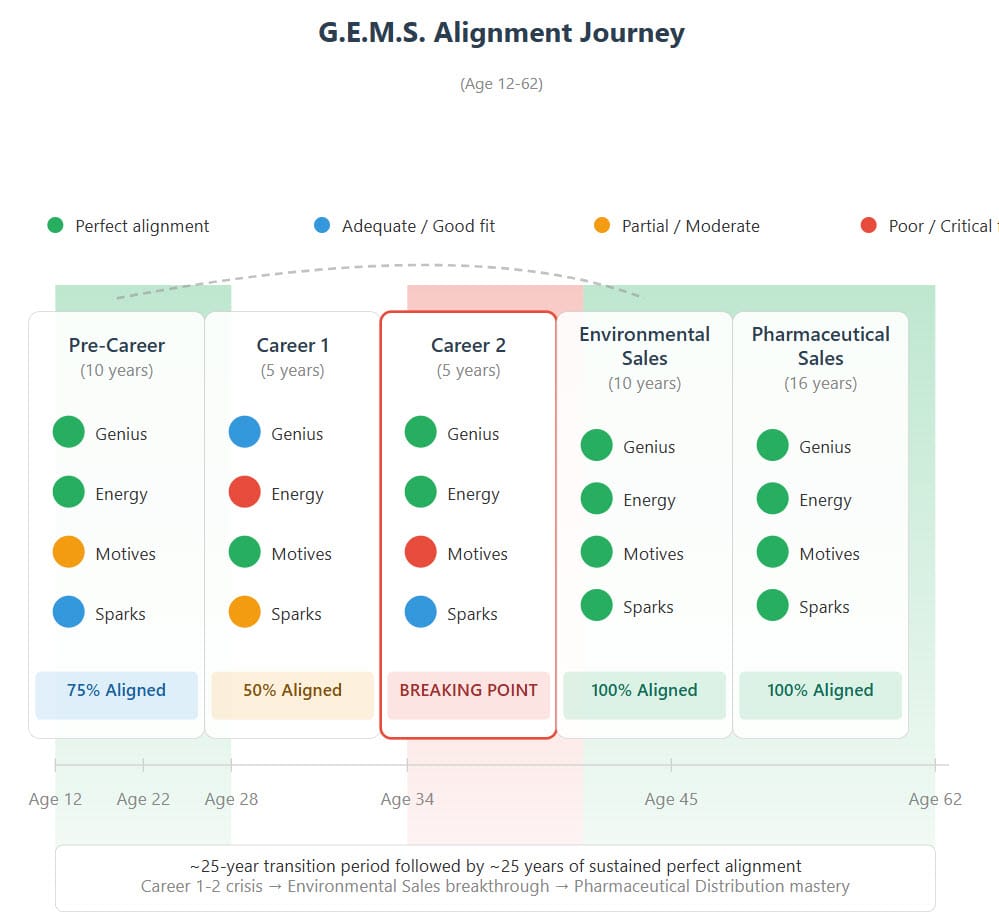
Pre-Career (Ages 12–22): G + E perfect, M/S underdeveloped → Effortless but temporary
Career 1 (Consultant): M aligned, G + E broken → Values alone can't sustain
Career 2 (Broker): G + E crushing it, M betrayed → Success without values = burnout
Career 3 (Sales → VP): All four aligned → 28 years of sustained excellence
Career 4 (below): (Career Coach): Paying it forward, legacy
The Pattern:
You can succeed with partial alignment. You can win competitions, earn good money, and look like you're winning.
But you can't be sustained on partial alignment.
One misaligned element creates friction. Two create pain. Three create a crisis.
All four aligned? That's not just success. That's a career that pays you, fulfills you, and makes a difference.
The Turning Point Was the Language
What changed between Career 1 and Career 3 wasn't my abilities or personality. Those stayed the same throughout.
What changed was that I finally understood them. I could see the pattern. I could name it. And once you can name something, you can design around it.
That's the difference between a career that happens to you and a career you design.
Career 4: Career Coach & Paying It Forward
From Personal Discovery to a Framework for Everyone
Here's what intrigued me as I retired: I spent many years searching, never finding solid alignment. But that time shaped who I am today. But I made three major pivots that weren't necessary.
With the right framework, I could have saved time searching.
I could have exited Career 1 with clarity, not confusion.
I could have prevented Career 2 entirely.
I could have designed Career 3 earlier.
That's 12 years of alignment and clarity I could have had, but I had to earn them the hard way: through trial, error, and finally, discovery.
The Thought Experiment:
What if I'd understood my G.E.M.S. at 22 instead of 34?
What if every high school senior could walk into their college choice with their complete G.E.M.S. profile in hand?
What if every MBA graduate knew not just what they could do, but what they should do?
What if career change felt less like a desperate escape and more like intentional design?
That's not fantasy. That's just building on what I finally learned after 40 years.
Why Career Prism Network℠ Exists:
I founded this because the discovery that changed my life shouldn't require multiple years of iteration. Life moves too fast and is too expensive for you to waste time wandering and wondering. The G.E.M.S. framework is repeatable. It works for high school seniors and 50-year-old career changers. It works across industries because it works for you, not around you.
My colleagues—Jim, Shamoon, Stephanie—bring different perspectives to this work. But we're all aligned on one thing:
Every person deserves to understand their G.E.M.S. before designing their career around it.
The earlier you know yourself, the fewer unplanned pivots you need.
The fewer pivots you need, the faster you compound your skills, your relationships, and your impact.
Yet, it is never too late to discover your G.E.M.S. and design a career - or a purposeful pursuit for retirement.
Your Turn
What Your G.E.M.S. Profile Will Reveal
If you've been following this series—reading Jim's Genius, Jim's Energy, Shamoon's Motives, Stephanie's Sparks—you've been building a picture of your own profile piece by piece.
Now imagine having it all at once—all four elements in a single, coherent snapshot.
The language to articulate what you've always intuited.
The framework to design your next move with intention instead of desperation.
What A Complete Profile Gives You:
Clarity — No more guessing whether a career move is right. You can assess it against who you actually are.
Confidence — You're not trying to become someone else. You're designing around who you already are.
Longevity — Alignment compounds. A career built on your G.E.M.S. can sustain you for many years.
Impact — When you're not fighting yourself, you have energy left over to make a real difference.
One Framework. Four Elements. Your Design
This is what the framework does in action. It explains career moves that felt random at the time. It reveals why some roles energized you while others drained you. It shows why success in one career wasn't enough—because something else wasn't aligned.
My career journey wasn't efficient. It was circuitous, expensive, and emotionally costly. But watching it through the lens of my G.E.M.S. Profile, I can see exactly where each pivot was necessary and where it could have been prevented.
Here's what I know now: Your G.E.M.S. is already complete. It's been written since you were 12 years old, showing up in the work that felt effortless, the environments where you thrived, the problems that pulled at your attention, the values you refused to compromise.
One framework. Four elements. Infinite career possibilities.
Your career doesn't have to be a series of accidents. You've just watched four real careers explained by one profile.
Now it's time to see what yours reveals.
Discover Your G.E.M.S. Profile in Action and design your career with intention.

Data-driven career coaching for first paths, fresh starts & next chapters, delivered virtually nationwide.
Schedule a Free Intro SessionCareer Prism Network℠ is a collective of independent practitioners. Each practitioner operates through their own separate legal entity, and clients engage services directly with the individual practitioner's firm.
Information on this website and in our materials is for career design and educational purposes only. It does not constitute mental health, clinical, legal, tax, or investment advice. Please consult a qualified professional for those concerns.
Career Prism Method℠, Career Prism Network℠, G.E.M.S. Profile™, Career Spectrum™, Career Design Blueprint™, Academic Assurance™, and Adaptive Pivot™ are service marks or trademarks of Raymond Giese of Career & Financial Pathways LLC.