Employers Are Already Measuring You. Here’s How to Measure Them Back.
By Ray Giese, CCSP, MS
Career Strategist & Founder, Career Prism Network
Hiring is changing. A recent Wall Street Journal article, The Job Interview Is Broken. Here’s How AI Could Actually Fix It describes employers moving away from loose, gut-feel interviews toward structured questions, scenario-based exams, and even VR simulations that drop a candidate into a simulated workday to see what they actually do under pressure. The reason for the shift isn’t flattering: one survey cited in the piece found that nearly a third of hiring managers had made a bad hire in just the past two years, most often because they misjudged a candidate’s skills or fit.
Here’s what that shift actually means for you. If employers are getting more rigorous about testing what you can actually do, you need to be at least as rigorous about knowing it yourself first, for two reasons: so you can perform well when it’s your turn in the room, and more importantly, so you can use that same information to screen the employer and the role right back.
The Career Prism Method℠ is built for exactly this. Think of raw potential as white light: stare at it directly, and it’s just one blinding beam. Run it through a prism, and it splits into a clear, distinct spectrum you can actually see and choose from. We do the same with your career, using objective data instead of a guess.
What Employers Are Already Trying to Measure
Strip away the VR headsets and the scoring models, and what these new hiring tools are actually trying to measure isn’t that different from what the Career Prism Method℠ measures in its Discover phase. They want to know how you solve problems under real conditions, not how you describe solving them in a resume bullet. They want to know how you work with a team, what kind of environment brings out your best, and whether the role actually lines up with what drives you. That’s Genius, Energy, and Motives, measured from the outside, under pressure, after you’ve already accepted the interview. We measure the same four traits deliberately, with real data, before you ever walk into the room.
Your G.E.M.S.
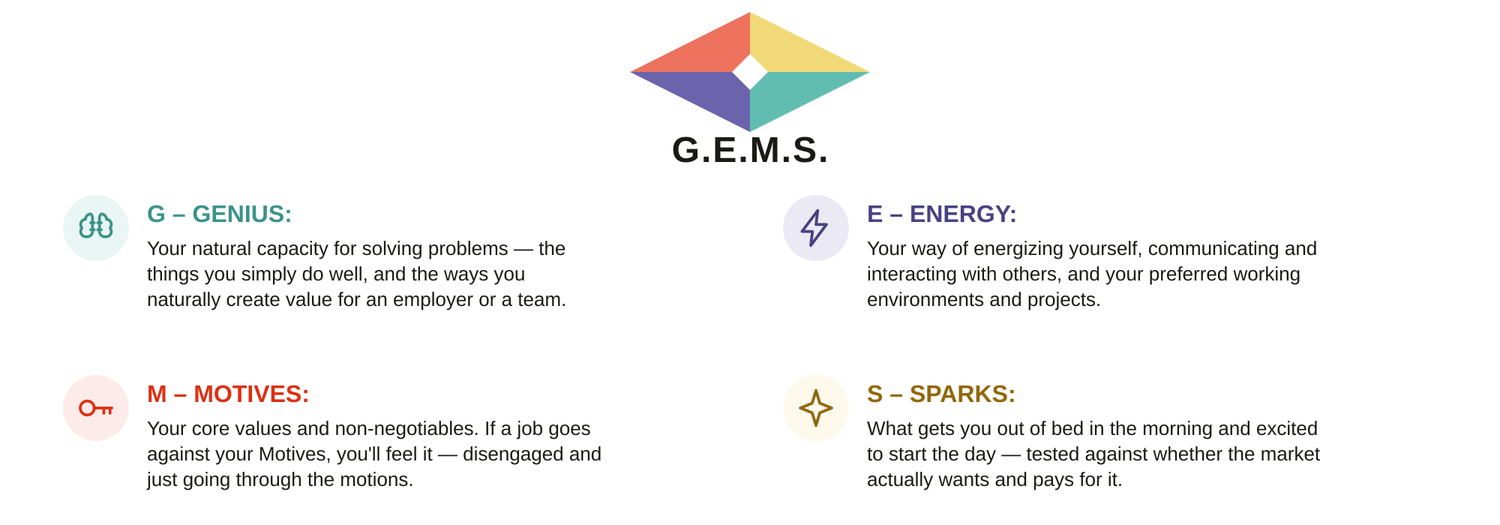
Four traits make up your prism:
G – Genius: Your natural capacity for solving problems, the things you simply do well.
E – Energy: How you energize yourself, communicate, and work best with others.
M – Motives: Your core values and non-negotiables. Work against them, and you’ll feel it.
S – Sparks: What gets you out of bed excited — provided the market will actually pay you for it.
Put those four together, and you get your G.E.M.S. Profile™ — a clear picture of how you’re wired, in language you can actually use in an interview, in a negotiation, or in the moment you’re deciding whether to accept an offer at all.
Use the Same Data to Screen Them Back
Here’s the part most people miss. The same self-knowledge that helps you perform well in a structured interview is what lets you evaluate a potential employer or role before you accept it, not several months in, once you’re already stuck. Most people don’t find out a role violates their Motives, or that a team’s pace fights against their Energy, until they’re quietly miserable two months into the job.
With your G.E.M.S. Profile™ in hand, you can ask sharper questions in the interview, read the actual environment instead of the job description, and walk away from an offer that looks good on paper but isn’t actually built for how you work, before it costs you a year of your life.
None of this is theoretical for the method’s founder, Ray Giese. Over a forty-year career, he worked across four distinct careers and seven industries, holding more than fifteen job titles along the way, which means he sat through more interviews and hiring processes than most people ever will. What got him through wasn’t a better resume. It was knowing, concretely, what he did well and what he needed from a role, walking in. That same starting point is exactly what the Career Prism Method℠ measures first.
The 4-Phase Design Process
Discover: We measure your G.E.M.S. — your baseline.
Explore: We map that baseline against your Career Spectrum™, the real-world fields and roles where your traits are in demand.
Decide: We pressure-test the strongest options through informational interviews and real research, so you choose with your eyes open, hard days included.
Pivot or Launch: We turn the decision into your Career Design Blueprint™, the plan that shows where you are now, where you’re headed, and the steps that connect the two.
Choose Your Design Path
You don’t have to keep guessing, and neither does your next interview.
For Adults: See how the Adaptive Pivot™ works: www.mycareerprism.com
Helping a student navigate this instead, or thinking it through as a parent? See how Academic Assurance™ works in that specific situation: https://www.mycareerprism.com/our-approach
About Ray Giese, CCSP, MS & Founder, Career Prism Network℠:
After a 40-year career spanning four distinct careers, seven industries, and more than fifteen job titles, Ray Giese knows firsthand that career change doesn't have to mean starting from scratch. That experience became the foundation for the Career Prism Method℠ and the reason he founded the Career Prism Network℠.
A Career Strategist and Certified Highlands Consultant, Ray treats career planning as a repeatable design process rather than a leap of faith — one that trades anxiety and confusion for a clear, purposeful path forward. He's also his own best case study: he used this exact approach to navigate his own pivots without losing the professional equity he'd spent decades building. The result is a career plan that doesn't just sound good on paper — it pays the bills and becomes a reliable economic engine.
#CareerDesign #CareerPrismMethod #FutureOfHiring #AdaptivePivot